
Governor Landry Vetoes Unanimous Bipartisan Bill That Would Help Innocent People Wrongfully Imprisoned for Decades
SB 125 would have helped men wrongfully convicted for 20, 30, or even 40 years, and was unanimously supported by legislators. The Governor’s veto falsely suggests abuse of the compensation process while ignoring the real victims of Louisiana’s failures.
NEW ORLEANS — On June 3, 2026, Governor Jeff Landry vetoed Senate Bill 125, a unanimous bipartisan bill that would have modestly increased compensation for innocent people wrongfully convicted and imprisoned in Louisiana.
SB 125, authored by Senator Gerald Boudreaux, would have raised Louisiana’s wrongful conviction compensation cap from 10 years to 15 years. The bill passed unanimously at every step of the legislative process: 36-0 in the Senate, 98-0 in the House, and 32-0 on Senate concurrence. It advanced through four committees without objection. It had 78 co-authors from both parties. In a session where almost nothing moved without division, SB 125 earned full bipartisan support at every step.
Despite that, Governor Landry made SB 125 the only bill he has vetoed this session.
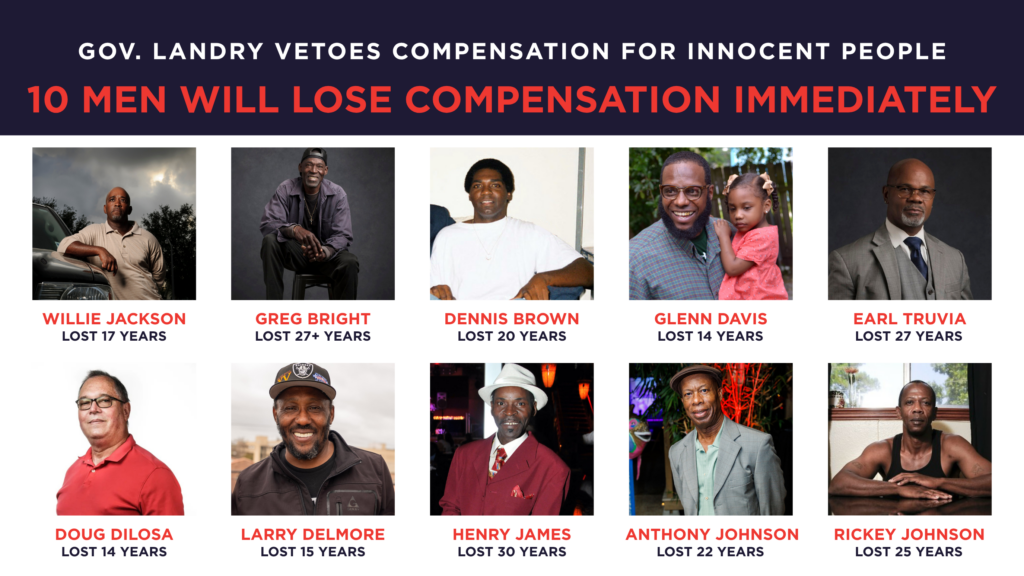
“This veto is not just disappointing. It is wrong, and it is harmful,” said Jee Park, Executive Director of Innocence & Justice Louisiana (IJLA). “The Governor’s message makes specious assertions about abuse without acknowledging who will suffer because of his veto. There are 10 people who were exonerated in five different parishes around the state whose innocence has already been vetted by the courts, who will not receive compensation this year because of the Governor’s veto.”
Park continued, “SB 125 is about real people who are innocent, real decades lost, and real families who lived with the consequences of Louisiana’s mistakes. Henry James is a real person. Greg Bright is a real person. Dennis Brown, Glenn Davis, Earl Truvia, Larry Delmore, Anthony Johnson, and Rickey Johnson are real people. These are men whose lives were taken by wrongful convictions, and Louisiana has a responsibility to repair what it can—a responsibility recognized by every member of the Legislature who voted for this bill.”
Senator Gerald Boudreaux (D-Lafayette) said, “The unanimous passage of SB 125 was a triumph of democracy: members of all parties came together and spoke with one voice in support of wrongfully convicted people. I am proud of my colleagues in the Legislature for their thorough vetting of this bill and for standing up for victims of wrongful conviction. I am especially grateful to Senator Jay Morris, Chair of Senate Judiciary C, and Representative Debbie Villio, Chair of the House Committee on the Administration of Criminal Justice, for working with me to move the bill through their committees.”
Louisiana’s current law provides $40,000 per year for up to 10 years. That means an innocent person who served 20, 30, or 40 years receives compensation for only 10 of those years, and only after a separate court proceeding where they must prove to a judge that they are factually innocent.
Even if the cap were raised to 15 years, Louisiana would still trail many states, being one of only a few states with a year cap on wrongful conviction compensation, while 29 states and Washington, D.C. have no year cap at all. By vetoing SB 125, Governor Landry kept Louisiana behind the national standard and left innocent people uncompensated for years, even decades, of wrongful imprisonment.
Greg Bright, an IJLA client, spent 27 years, 7 months, and 10 days in prison for a murder he did not commit. He was convicted based on the testimony of a single witness who was proven to have lied. He was released in 2003 after the state dismissed all charges. The only compensation he has received is for 10 of the years of his wrongful imprisonment. SB 125 would have at least allowed him to be compensated for another 5 of his 27 years in prison.
“Twenty-seven and a half years is not a number on paper. That was my life,” said Greg Bright. “I lost years that I can never get back, no matter what. I lost time with my family. I lost the chance to build a life the way other people do. All those years counted when I was locked up. They should count now.”
This fall, compensation payments are set to cap for people who have already lost far more than Louisiana’s 10-year cap recognizes:
Greg Bright, who lost more than 27 years to wrongful conviction;
Dennis Brown, who lost more than 20 years;
Glenn Davis, who nearly 15 years;
Larry Delmore, who lost over 15 years;
Doug DiLosa, who lost 14 years;
Henry James, lost 30 years;
Willie Jackson, who lost 17 years;
Anthony Johnson, who lost more than 22 years
Rickey Johnson, who lost 25 years; and
Earl Truvia, who lost more than 27 years.
“The Governor’s veto is a setback, but the momentum for this desperately needed reform is in our favor,” said Sen. Boudreaux. “Innocent people sent to prison should never be short-changed when it comes to how they were harmed by our criminal justice system. SB 125 united people across the State in support of this principle. Together, we will continue to fight for justice for the wrongfully convicted.”